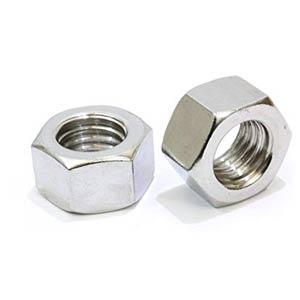
Standard Heavy Hex Nuts are robust, six-sided fasteners known for their larger size and heavier design compared to standard hex nuts. They are commonly used in structural applications and in conjunction with heavy-duty bolts, providing increased strength and load-bearing capabilities.
Heavy hex nuts have a thicker body and larger width across flats than regular hex nuts, making them ideal for demanding, high-stress applications in construction, industrial machinery, and heavy equipment.
High Load-Bearing Capacity: Due to their larger and thicker design, heavy hex nuts distribute load more effectively, which is beneficial for high-tension applications.
Increased Torque Resistance: Heavy hex nuts can withstand higher torques, reducing the likelihood of loosening under vibration or stress.
Enhanced Stability: The larger surface area of heavy hex nuts allows for better stability, reducing the chance of rotation under load.
Corrosion Resistance: Heavy hex nuts can be manufactured with coatings or materials such as stainless steel to resist corrosion, making them suitable for outdoor and harsh environments.
Temperature Resistance: Heavy hex nuts are available in materials that withstand high temperatures, which is crucial for industrial and structural applications.
Heavy hex nuts are produced in accordance with various industry standards to ensure consistency in dimensions, performance, and quality. Some commonly referenced standards include:
ASTM A194: Standard specification for heavy hex nuts used in high-pressure or high-temperature services, particularly in bolting for pressure vessels, valves, and flanges.
ASTM A563: Specifies material and dimensional requirements for heavy hex nuts in structural applications.
ISO 4032: International standard covering hex and heavy hex nuts, providing requirements for properties, dimensions, and mechanical performance.
ASME B18.2.2: Specifies dimensions, materials, and mechanical requirements for heavy hex nuts for industrial and structural applications.
These standards ensure that heavy hex nuts are compatible with various grades of bolts and can withstand required stresses and environmental conditions.
Heavy hex nuts are manufactured from various materials depending on the specific application requirements:
Carbon Steel: Most common, provides high tensile strength and durability. Frequently used with structural bolts in construction and general industrial applications.
Alloy Steel: Enhances strength and hardness, suitable for applications needing extra resistance to wear and stress.
Stainless Steel (Grade 304/316): Corrosion-resistant and suitable for environments exposed to moisture, chemicals, and temperature fluctuations.
High-Strength Steel (Grade 8 and above): Offers increased hardness and is typically heat-treated, making it ideal for high-stress, heavy-load environments.
Coated Finishes (e.g., Zinc, Galvanized, Phosphate): Provides corrosion resistance for applications exposed to harsh conditions. Zinc or hot-dip galvanizing is common for outdoor environments.
Sizes: Heavy hex nuts come in both standard and metric sizes, generally ranging from 1/4 inch up to 2 inches (or M6 to M48 for metric).
Threading:
Grades:
Coatings and Finishes: